

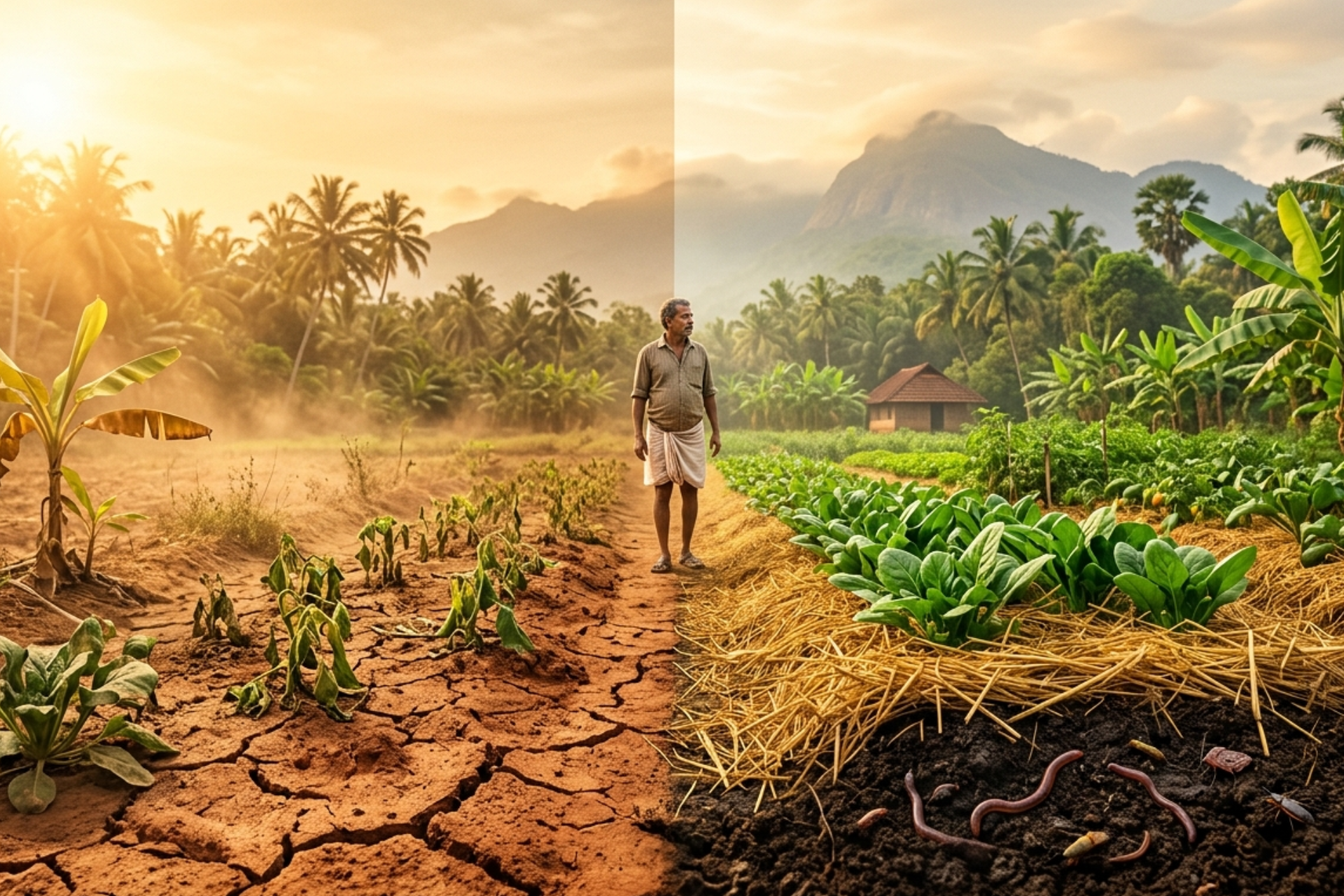
In Kerala’s tropical climate, farming is not just about what you grow it’s about how you manage water, soil, and heat. Many farmers across Palakkad, Thrissur, and Malappuram face the same recurring problems: rapid soil drying, aggressive weed growth, declining soil health, and inconsistent yields.
What if one simple, low-cost practice could address all of these at once? Mulching the practice of covering soil with organic material is one of the most powerful yet underutilized tools in South Indian agriculture.
A Real-World Observation
Consider this:
Two vegetable beds.
Same soil. Same seeds. Same planting day.
- One bed is covered with 3 inches of straw mulch
- The other is left bare
Within 60–90 days, the difference becomes dramatic.
The bare soil:
- Dries out within 1–2 days after watering
- Develops surface cracks under heat
- Gets overtaken by weeds
- Shows stressed plants (bolting greens, stunted growth)
The mulched soil:
- Retains moisture for 4–5 days
- Remains soft and cool
- Has minimal weed growth
- Supports healthier, more productive plants
This is not theory — it is consistently observed across organic farms in Kerala.
Why Mulching Works (Backed by Data)
1. Moisture Retention
Kerala receives heavy rainfall, but water management is still a challenge due to:
- Sandy or laterite soils in many regions
- High evaporation rates during summer
Studies from Indian agricultural universities show that mulching can reduce soil moisture loss by 30–50%.
This means:
- Fewer irrigation cycles
- Lower water costs
- Better drought resistance during dry spells
For farmers in Palakkad, where summer temperatures can cross 38°C, this is critical.
2. Soil Temperature Control
Bare soil absorbs direct sunlight, raising temperatures significantly. In Kerala’s climate, soil temperatures can exceed optimal root-zone levels.
Mulch acts as insulation.
- Reduces soil temperature by 2–5°C
- Protects beneficial microbes
- Prevents root stress
Cooler soil means:
- Better nutrient uptake
- Less plant shock
- Extended growing period for crops like spinach, coriander, and lettuce
3. Weed Suppression
Weeds compete for nutrients, water, and sunlight. Managing them manually increases labour costs.
Mulching blocks sunlight from reaching weed seeds.
Result:
- Up to 80–90% reduction in weed growth
- Lower labour requirement
- Reduced dependency on herbicides
This is especially useful for organic farmers.
4. Soil Health & Microbial Life
Healthy soil is living soil.
When you pull back mulch in peak summer and still find earthworms near the surface, it indicates:
- High microbial activity
- Improved organic matter
- Better aeration
Over time, decomposing mulch:
- Adds carbon to soil
- Improves structure
- Enhances water-holding capacity
This directly supports long-term fertility something chemical farming often depletes.
5. Yield Improvement
With stable moisture, reduced stress, and better soil health, crops perform better.
Field observations and trials show:
- Yield increases of 15–30% in mulched vegetable systems
- Better fruit size and quality
- Extended harvesting cycles
For small farmers, this directly translates to higher income without increasing input cost significantly.
Best Mulching Materials for Kerala
Kerala has a natural advantage — abundance of organic material.
Straw (Paddy Residue)
- Easily available in paddy-growing regions like Palakkad
- Decomposes slowly
- Ideal for vegetable beds
Coconut Leaves & Husk
- Readily available in most households
- Long-lasting
- Great for tree crops like coconut, banana, and arecanut
Shredded Leaves
- Free and abundant
- Break down quickly
- Excellent for enriching soil
Grass Cuttings
- Useful but should be dried before use
- Avoid thick wet layers to prevent fungal growth
Wood Chips
- Best for perennial crops and pathways
- Not ideal for annual vegetables due to slow decomposition
How to Apply Mulch (Practical Guide)
- Thickness: 3 inches (7–8 cm)
- Keep 1 inch gap around plant stems to prevent rot
- Apply after watering or rainfall
- Replenish as it decomposes
For crops like turmeric, banana, vegetables, and even coconut, mulching can be applied at different stages.
Why This Matters for the Future
Kerala’s agriculture is at a crossroads.
Challenges:
- Rising input costs
- Water scarcity during summer
- Soil degradation
- Climate variability
Mulching offers a solution that is:
- Low-cost
- Locally available
- Sustainable
- Scalable
For initiatives like Vayonadha, which focus on organic and regenerative farming, mulching aligns perfectly with long-term goals.
Future Impact
If widely adopted:
- Water usage in farming can reduce significantly
- Soil fertility can improve naturally
- Farmers can reduce dependency on chemical inputs
- Crop resilience against climate change can increase
This is not just a farming technique — it is a shift towards regenerative agriculture.
Final Thought
One afternoon of mulching can save:
- Dozens of hours of weeding
- Thousands of litres of water
- Significant crop loss
In a place like Kerala, where nature provides abundant organic matter, leaving soil bare is not just inefficient it is a missed opportunity.
Mulch is not an extra step. It is a foundational practice. And sometimes, the smallest changes create the biggest transformation.