
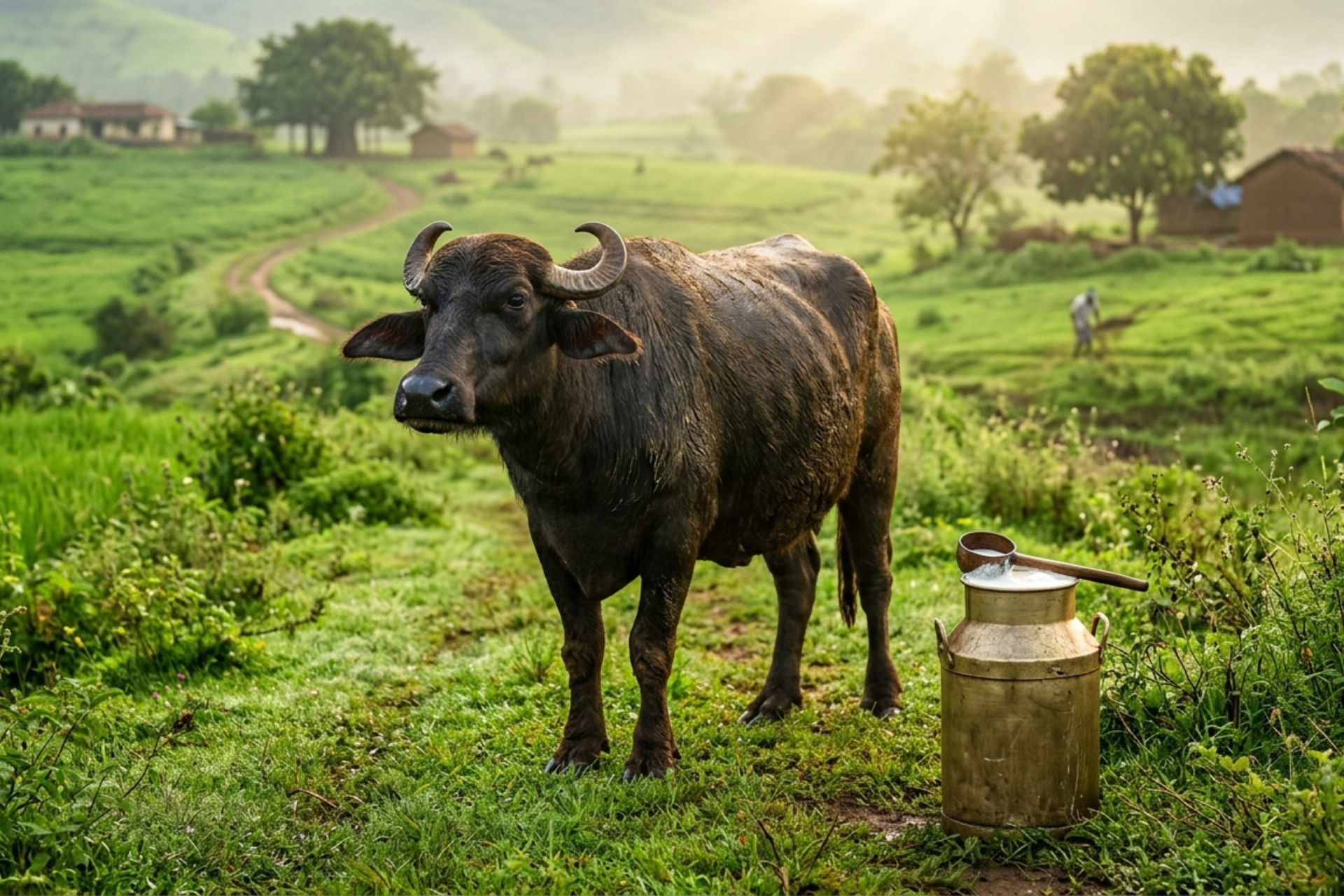
Long before dairy became industrialized and milk arrived in plastic packets at supermarket shelves, India’s villages lived closely with their native animals. Among them stood one of the most hardworking and underestimated companions of rural life the buffalo.
Strong, calm, resilient, and deeply woven into India’s agricultural history, the buffalo has quietly nourished generations with rich milk, powerful nutrition, and sustainable farming support. Today, as consumers begin questioning processed foods, chemical-heavy farming, and the growing concerns around modern dairy systems, buffalo milk is making a remarkable comeback.
For the readers of Vayondha and for farmers, animal husbandry practitioners, and wellness-conscious families, this is more than a conversation about milk. It is about returning to stronger genetics, natural nutrition, sustainable farming, and traditional wisdom.
The Ancient Relationship Between Humans, Cows, and Buffaloes
India’s dairy history is thousands of years old. Ancient civilizations of the Indus Valley already practiced cattle domestication, and over centuries, both cows and buffaloes became central to Indian agriculture.
Buffaloes were especially valued in regions with hot climates, wetlands, and river belts. Unlike many delicate modern dairy breeds, buffaloes adapted naturally to Indian environmental conditions. They worked in farms, pulled carts, survived harsh weather, and produced rich milk even under challenging circumstances.
Traditional Indian households did not separate agriculture from livestock. Buffaloes and cows were part of an ecosystem:
- Animal dung fertilized fields
- Crop residues fed animals
- Milk nourished families
- Ghee became medicine and food
- Farmers survived through integrated farming
This natural balance sustained rural India for centuries.
The Rise of Crossbred Dairy Cows
The dairy revolution in India changed everything.
During and after Operation Flood, India focused heavily on increasing milk production. Foreign breeds like Holstein Friesian and Jersey cows were introduced and crossbred with Indian cattle to improve milk yields.
This succeeded economically in many ways. India became one of the world’s largest milk producers. But there were consequences.
Over time, many farmers noticed that highly crossbred cows:
- Required expensive feed
- Were more disease-prone
- Needed intensive medical care
- Had lower heat tolerance
- Faced fertility challenges
- Struggled in tropical conditions
At the same time, traditional native cattle and buffalo breeds slowly declined in importance. Buffaloes, however, remained genetically more stable compared to heavily modified crossbred dairy cows. Many indigenous buffalo breeds still retain strong natural adaptation traits developed over centuries.
Why Buffaloes Have Undergone Less Genetic Alteration
One major reason buffaloes have retained stronger traditional genetics is that large-scale industrial genetic manipulation focused more heavily on cows than buffaloes.
Crossbreeding programs mainly targeted high-yield exotic cow breeds. Buffalo breeding improved selectively, but without the same aggressive industrial intervention seen in modern dairy cows.
As a result, many buffalo breeds today still preserve:
- Better disease resistance
- Strong digestive ability
- Heat tolerance
- Longevity
- Natural grazing adaptation
- Higher resilience in village farming systems
Popular Indian buffalo breeds like Murrah, Jaffarabadi, Mehsana, Pandharpuri, and Surti continue to remain important to rural economies.
For sustainable farming, this matters tremendously.
Buffalo Milk vs Modern Cow Milk
Buffalo milk is very different from the milk most urban consumers drink daily.
It is naturally:
- Thicker
- Creamier
- Higher in fat
- Richer in protein
- More filling
- Better suited for value-added products
Buffalo milk contains significantly higher calcium, phosphorus, and healthy fats compared to many commercial cow milk varieties.
This is why traditional Indian sweets, khoa, paneer, curd, and ghee were often prepared using buffalo milk.
For hardworking agricultural families, buffalo milk provided sustained energy and nourishment.
Understanding A1 and A2 Milk
One of the biggest modern discussions in dairy nutrition revolves around A1 and A2 milk proteins.
Milk contains a protein called beta-casein. There are different types of this protein:
- A1 beta-casein
- A2 beta-casein
Many native Indian cattle and buffaloes naturally produce A2-type milk. Some modern crossbred and exotic cows produce A1 protein, which researchers have studied for possible links to digestive discomfort and inflammation in certain individuals. While scientific debate continues and evidence is still evolving, many consumers report that they digest A2 milk more comfortably.
Buffalo milk is generally considered naturally A2 in composition.
This has significantly increased interest in:
- Native cattle milk
- Buffalo milk
- Traditional dairy systems
Consumers are now searching for dairy products closer to what earlier generations consumed naturally.
Why Buffalo Milk Is Becoming Popular Again
1. Better Satiety and Nutrition
Buffalo milk’s higher fat and protein content makes it more satisfying and energy-rich. In rural India, it has long been considered strengthening food for children, workers, and recovering patients.
2. Excellent for Traditional Dairy Products
Buffalo milk produces superior:
- Paneer
- Ghee
- Butter
- Curd
- Khoa
- Ice cream
- Mozzarella cheese
In fact, authentic Italian mozzarella traditionally uses buffalo milk.
3. Potentially Easier Digestion for Some Consumers
Many consumers seeking A2 milk alternatives prefer buffalo milk because it feels gentler on digestion compared to heavily processed commercial milk.
4. Lower Water Content
Buffalo milk contains less water and more solids, making it valuable for dairy businesses and value-added processing.
5. Sustainable Rural Farming Option
Buffaloes adapt well to Indian climates and local feeding systems. For many farmers, this means:
- Lower veterinary costs
- Better survival rates
- Reduced dependence on imported genetics
- Stronger integration with natural farming
Value-Added Buffalo Milk Products: A Huge Opportunity
For farmers and agri-entrepreneurs, buffalo milk offers tremendous business potential.
Buffalo Ghee
Rich, aromatic buffalo ghee is gaining premium demand among health-conscious consumers. It is widely used in traditional cooking and Ayurveda-inspired diets.
Artisanal Paneer and Cheese
Buffalo milk paneer has superior texture and yield. Specialty cheeses made from buffalo milk are now entering premium markets.
Traditional Fermented Products
Curd, buttermilk, and probiotic dairy products made from buffalo milk can align strongly with wellness branding.
Natural Sweets and Desserts
Traditional Indian sweets prepared from buffalo milk have excellent market value and nostalgic appeal.
Organic and A2 Dairy Branding
Consumers increasingly want traceable, ethical, minimally processed dairy. Buffalo milk farms practicing natural feeding and chemical-free management can command premium pricing.
For brands like Vayondha, this represents an opportunity to reconnect ancient nutrition with modern wellness markets.
Challenges Buffalo Farmers Still Face
Despite the advantages, buffalo farming also faces challenges:
- Mechanization reduced demand for working buffaloes
- Urban land pressure affects grazing
- Younger generations move away from livestock farming
- Dairy industries often favor high-volume systems
- Traditional knowledge is disappearing
Many small-scale farmers struggle with market access and value addition opportunities. However, the growing wellness movement may reverse this trend.
The Future: Returning to Stronger Food Systems
The future of Indian dairy may not lie only in increasing quantity. It may lie in improving quality, sustainability, genetics, and trust.
Consumers today are asking:
- Where does my food come from?
- What are the animals fed?
- Is the milk heavily processed?
- Is it natural?
- Is it ethical?
Buffalo milk answers many of these questions naturally.
For agriculture practitioners and animal husbandry farmers, buffalo-based dairy systems can become part of a more resilient farming future:
- Integrated farming
- Organic agriculture
- Natural manure systems
- Local breed conservation
- Rural entrepreneurship
More Than Milk — A Living Heritage
The buffalo is not merely a milk-producing animal. It represents endurance, balance, and coexistence with nature. For centuries, it stood beside Indian farmers through droughts, floods, hard labor, and changing seasons. It gave milk, manure, strength, livelihood, and security.
Today, as industrial food systems show their limitations, the quiet wisdom of traditional livestock systems is returning into focus. Perhaps the future of health is not hidden in laboratories or synthetic nutrition products. Perhaps it has been standing in our villages all along beside the farmer, under the shade of a tree, chewing slowly, patiently sustaining human life generation after generation.