
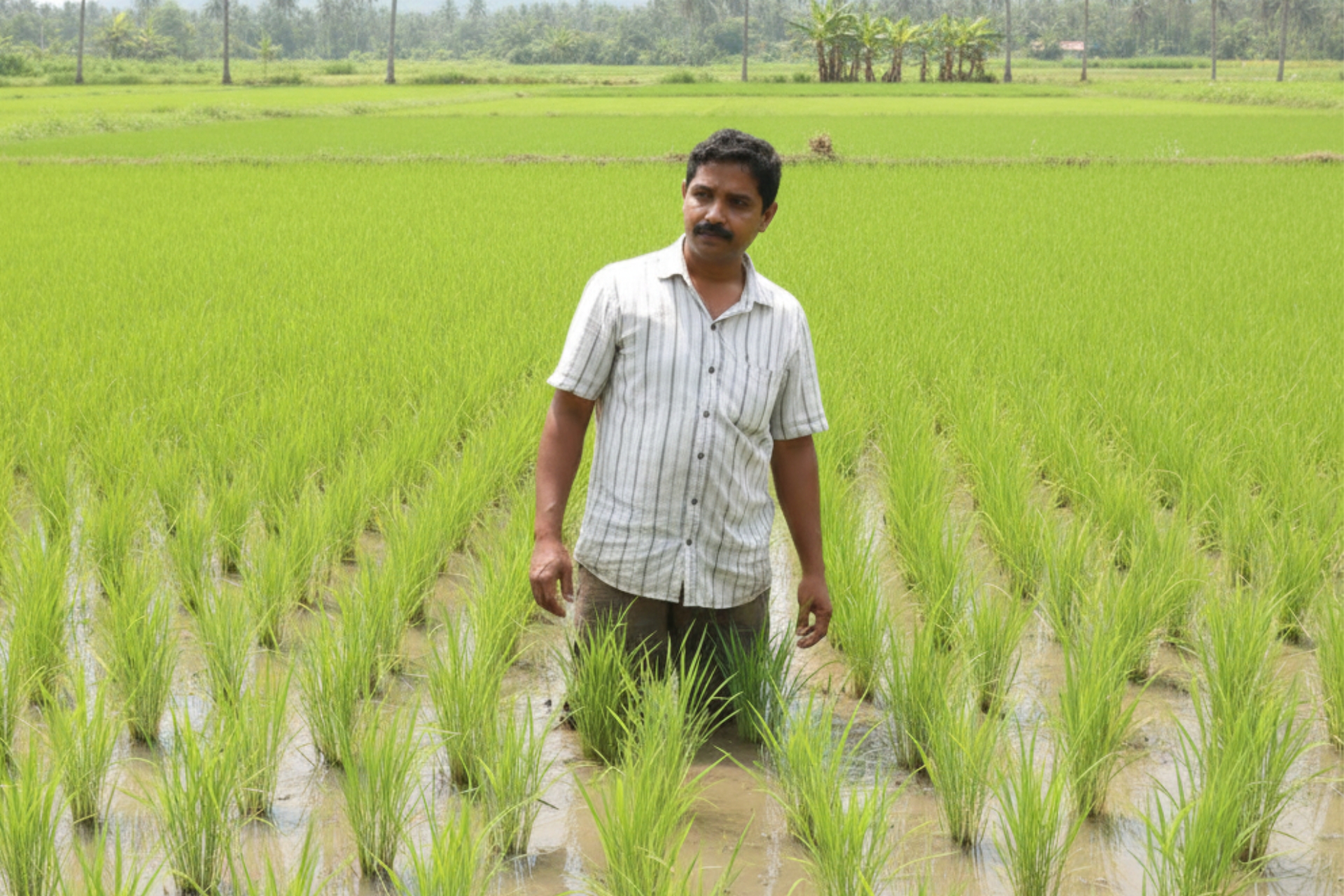
An Interview with Illiyas KP: Illiyas KP, a passionate advocate for organic farming and the conservation of traditional rice varieties, we explore his journey from humble beginnings to becoming a leading figure in the world of organic agriculture. With a rich history rooted in the culture of Kerala, Illiyas has dedicated his life to preserving the soil, seeds, and values of ecological farming. Here’s a closer look at his journey and vision.
Early Life and the Spark for Farming
Born and raised in Kallayi, a small town in the Kozhikode district of Kerala, Illiyas had a humble beginning. “I grew up as one of six children in a family with just five cents of land—barely enough to build a home, let alone dream of farming,” he says. His father was a daily-wage labourer, and farming seemed like a distant dream. However, Illiyas’ natural curiosity about agriculture was piqued when he encountered a group of like-minded individuals in 2002.
This encounter happened when Illiyas stumbled upon the Kerala Jaiva Karshaka Samithi (KJKS), an organization dedicated to promoting organic farming across Kerala. “What started as a mere curiosity turned into a deep calling. At KJKS workshops and meetings, I met farmers who cultivated without chemicals. Their way of life—their food habits, respect for soil, and values—was inspiring. I realized that farming could be more than just a livelihood; it could be a profound connection to the earth,” Illiyas reflects.
He soon recognized that organic farming wasn’t just about the absence of chemicals; it was about cultivating an ecosystem where food, soil, and people were deeply connected. This new perspective shaped his future in ways he never anticipated.
From Learner to Practitioner
Despite being inspired by the KJKS network, Illiyas was not able to start farming immediately. It wasn’t until 2009, after five years of learning and immersing himself in organic practices, that he was able to secure an acre of land in Padety village under the Palakkad Panchayat. The opportunity to cultivate paddy, a crop central to Kerala’s agrarian landscape, was a turning point. However, it wasn’t just about farming—Illiyas also took on the role of Project Coordinator for the Agro-Biodiversity Restoration Project at Erimayoor Panchayat, an initiative implemented by the Kerala State Biodiversity Board in partnership with Thanal.
Through this project, Illiyas deepened his understanding of agro-biodiversity and sustainable farming practices. He became a key figure in building district-level groups and mentoring farmers who were hesitant about transitioning to organic farming. “I became an example of how it was possible to make the shift, even though it wasn’t always easy. My own experiences helped others see that transformation, though challenging, was entirely achievable,” he says.
Leadership in Organic Farming
Illiyas’ influence extended beyond his own farm. From 2009 onwards, he took on leadership roles in several organizations. As the State Secretary of One Earth One Life and later, the Kerala Jaiva Karshaka Samithi (KJKS) from 2012 to 2015, Illiyas played a pivotal role in shaping Kerala’s organic farming community. His work didn’t stop at the state level—he also became a Managing Committee Member of the Organic Farming Association of India (OFAI) and eventually the National President of OFAI in 2018.
In his leadership capacity, Illiyas focused on fostering farmer networks, sharing knowledge, and ensuring the sustainability of organic farming. “I wanted to create platforms where farmers could learn from each other and share resources. It was about building a collective strength for a movement that could stand the test of time,” he explains.
His influence spread across the country, as Illiyas took part in numerous conventions, workshops, and gatherings where he shared his insights on organic farming, traditional knowledge, and biodiversity conservation.
Specialization in Traditional Rice Cultivation
One of the cornerstones of Illiyas’ expertise lies in traditional rice cultivation, particularly the conservation of indigenous rice varieties. Over the years, he has cultivated rice across four districts in eleven padashekhara clusters, each with its own unique traditional varieties. “I’m deeply connected to traditional rice varieties. Each variety has a name, a story, and a purpose. They are more than just crops—they are part of Kerala’s rich agricultural history,” says Illiyas.
His deep knowledge of traditional farming practices and rice varieties has also led him to write a book titled “Nelkrishi Jaivareethiyil” (Organic Rice Farming). The book shares his journey, insights, and the wisdom behind traditional rice cultivation in an organic context. He is currently working on a new book titled “Purayidakrishi” that explores the concept of Homestead Agroecology (Purayidakrishi)—a model of sustainable farming that combines traditional knowledge with modern ecological practices.
Building a Legacy: The Purayidakrishi Model
Today, Illiyas nurtures a 4-acre organic farm in Shoranur, where he practices and teaches the Purayidakrishi model. This holistic approach to farming focuses on biodiversity, conservation, and self-sufficiency. His farm includes multiple varieties of rice, tubers, fruits, and vegetables, each grown following principles that harmonize with nature rather than overpower it.
“I believe that farming should be an integrated system, where soil, water, and crops coexist in a balanced, sustainable way,” Illiyas says. His farm also serves as a living laboratory where he tests new techniques and shares his findings with other farmers.
In addition to his own farm, Illiyas is a key member of the Akavayal collective, a group committed to preserving more than 100 traditional rice varieties. “We want to ensure that these varieties don’t disappear from our farms. They hold genetic diversity that is vital for future generations,” he adds.
Looking Ahead: A Call to Action
Illiyas’ journey is far from over. His work continues to evolve, and his message remains clear: the future of farming lies in reconnecting with traditional practices and respecting the natural world. “We must create a farming system that values ecological balance over profit and nurtures the earth rather than exploits it,” Illiyas urges.
Through his work with KJKS, OFAI, and his own farm, Illiyas remains committed to supporting organic farmers and conserving Kerala’s agricultural heritage. His story is a testament to the power of knowledge, persistence, and a deep connection to the land.
As Illiyas continues his journey, his vision for a sustainable future takes root, one field at a time. He encourages farmers, young and old, to embrace the wisdom of traditional farming practices and work together to create a more sustainable and equitable agricultural system for all.