

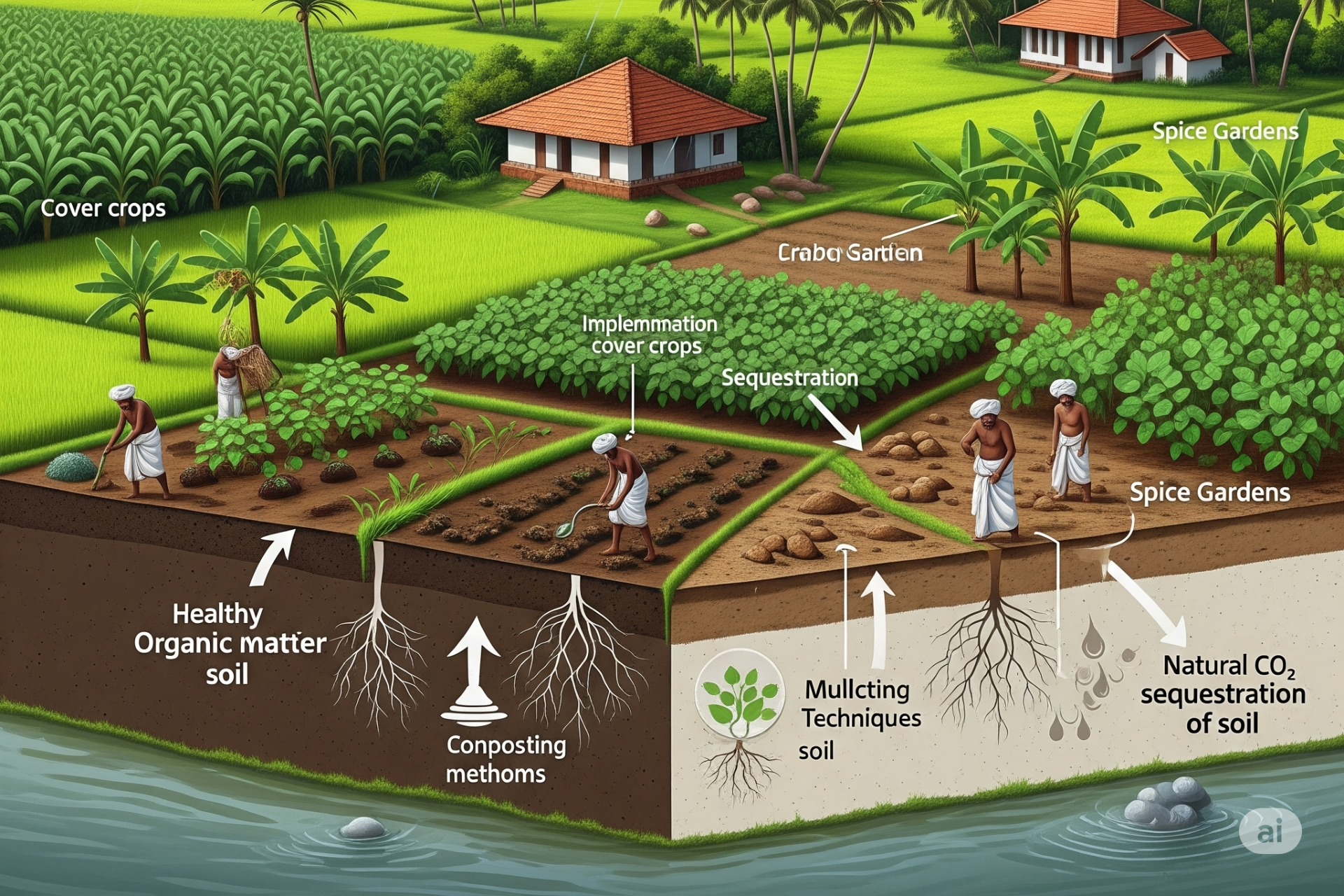
In the quiet but vital world beneath our feet, an invisible process is shaping the future of farming, food security, and even the climate: carbon sequestration in soil. As the world battles rising CO₂ levels and extreme weather, fixing carbon in the soil through regenerative agriculture—especially through cover cropping and living roots—offers not just hope, but a real, working solution. But why is this important? When and where should it be done? And what if we don’t act now? Let’s explore.
Why Do We Need to Fix Carbon in the Soil?
- Excess CO₂ in the Atmosphere:
The world now emits over 36 billion tonnes of CO₂ annually, pushing global temperatures to dangerous levels. Agriculture—especially ploughing, burning residues, and leaving soil bare—contributes nearly 24% of these emissions. - Soil Degradation Crisis:
When land is left bare after harvest, sunlight and wind oxidize organic matter, releasing stored carbon as CO₂. Globally, soils have lost 50–70% of their original carbon stock due to these practices, making fields less fertile and less resilient. - Kerala’s Landscape Problem:
Kerala’s traditional farming landscapes—especially paddy fields, banana farms, and plantations—are rapidly losing organic matter. Studies show that more than 60% of Kerala’s agricultural soils have critically low organic carbon (<0.5%), far below the 1.5–2% needed for healthy soil life. This contributes to:- Water scarcity in dry months (even in high-rainfall regions),
- Topsoil erosion during monsoons,
- Falling crop yields and rising input costs.
How to Fix CO₂ in the Soil?
- Cover Crops (Green Manure):
Growing crops like cowpea, sunn hemp, or horse gram during off-seasons. Their roots trap carbon below ground and their biomass feeds soil organisms. - No-Till or Minimum-Till Farming:
Avoid ploughing after harvest. It keeps soil structure intact and reduces carbon loss. - Mulching:
Leaving organic residues or leaves on the field surface shields the soil, conserves moisture, and slowly releases carbon. - Agroforestry:
Combining trees with crops boosts carbon capture in both soil and biomass. - Composting and Biochar:
Applying stable carbon-rich compost or biochar that remains in the soil for years.
When and Where Should We Do This?
- When:
Immediately after main crop harvest, especially during summer and pre-monsoon seasons when fields are traditionally left fallow and exposed. - Where:
- All crop lands (paddy, banana, vegetable, coconut, arecanut),
- Sloped lands prone to erosion,
- Even homestead gardens.
- Critical Areas in Kerala:
- Palakkad, Thrissur, and Wayanad districts (due to severe summer dryness and topsoil loss),
- Coastal sandy soils,
- High-range plantations losing organic content.
What if We Don’t Do It?
- Soil Fertility Crash:
Farmers will need to double their fertilizer use to maintain yields—a costly, unsustainable cycle. - Water Shortages:
Bare soils absorb less rain; Kerala’s groundwater table (already falling in Palakkad by 30-50 cm annually) will drop further. - Crop Failures & Pest Attacks:
Weak soils lead to stressed plants, which attract more pests and diseases. - Climate Impact:
Kerala’s farmlands could become net carbon emitters, worsening global warming.
Positive Points of Soil Carbon Fixing:
✅ Increases soil fertility & yield naturally,
✅ Reduces fertilizer and irrigation needs (up to 30-40% saving),
✅ Prevents erosion and nutrient leaching,
✅ Improves resilience to drought and flood,
✅ Creates better livelihoods for farmers.
Any Negatives?
⚠️ Initial cost of seeds or cover crop planting,
⚠️ Some extra effort in learning regenerative methods,
⚠️ May reduce space for immediate cash crops (but pays off long-term).
Who Is Doing This Successfully?
- USA (Iowa, Dakota):
Farmers restored over 8 million acres with cover crops, saving water and fertilizer. - Africa (Kenya, Ethiopia):
Agroforestry projects boosted soil carbon, drought tolerance, and incomes. - India (Punjab, Haryana):
Trials with green manures reduced chemical inputs by 20-25%, improved soil health. - Sikkim & Andhra Pradesh:
Organic and zero-budget farming movements show rising soil carbon, better yields.
Kerala’s Urgent Need for Carbon Farming:
✅ High rainfall = High erosion risk,
✅ Low summer rains = Water scarcity risk,
✅ Paddy and banana fields losing organic matter rapidly,
✅ Smallholder farmers (average landholding 0.18 ha) need low-cost fertility solutions.
If Kerala adopts soil carbon fixing now—especially in Palakkad, Wayanad, and Idukki—we can build resilient, water-saving, climate-friendly farmlands.
What Happens If We Act Now? (By 2030 Projections)
✔️ Potential to fix 2–3 tonnes of CO₂ per hectare per year,
✔️ Improve yields by 15–20% without extra fertilizer,
✔️ Reduce irrigation needs by 25%,
✔️ Cut pest attack risk by half,
✔️ Improve farmer incomes through carbon credit schemes (global market potential worth $50–100 per tonne CO₂).
Conclusion: A Small Step, a Big Future
Kerala’s farmers stand at a crossroads. Bare, tired soils cannot feed the next generation—but living, carbon-rich soils can. By planting cover crops, protecting living roots, and rethinking soil as a living carbon bank, we can build climate-resilient, profitable farms.
Let’s fix carbon—not just to fight climate change, but to rebuild Kerala’s farming prosperity.
Vayonadha encourages all farmers to learn and adopt regenerative practices. Contact us for guidance, seeds, and training resources!